Long time MTG guy. Just this minute registered an account here to see what the reaction is to this deck. It's the result of a handful of overlapping ideas of mine regarding a bunch of cards I happen to like, with strong influences from several specific decks that have defined their respective formats in their time. I'm a student of history when it comes to deck construction. I've solved more than one standard format with a legitimate broken deck. In the case of the most egregious offender, it went completely under the radar until the core rotated. I had just gotten back into MTG at the time, and didn't have an avenue to get it into any major events. Another one went on to see success in the hands of others at the GP and SCG levels. I offered it to a friend of mine who was competing in the PT for that format but it was too far out of his comfort zone, so it wasn't represented. Anyways... I'm not claiming this deck here today is anywhere remotely close to warping the format, but I thought I'd give a little background info for better context.
A couple basic premises that drove the initial concept:
- It's an underappreciated fact that Hangarback Walker with Arcbound Ravager is a powerful interaction regardless of the format.
- Two Vintage restricted cards that play well together and were both found guilty of being degenerate on separate occasions had been cornerstones of the ravager shops deck that sat at the top of the vintage food chain all the way up until it was no longer possible to play more than 2 copies of both cards combined. Naturally I'm referring to Chalice of the Void and Lodestone Golem, which is among the most oppressive one-two sequences available to open a game of magic.
- All the above cards were complementary pieces of the same overwhelmingly dominant deck. Though it's no longer a possibility to field a vintage deck containing as many of them as you like, it remains an option in legacy for now.
Why hasn't this territory been better explored in Legacy, independent of a metalworker shell and the well known flaws associated with that?
I wanted to answer that question without blindly attempting to recreate the exact parallels to the conditions achieved by a deck having access to a full set of power and Mishra's Workshops. The goal was intended to be realistic as opposed to insurmountable. I considered it likely that there are other applications for a framework containing such a high inherent power level. I knew that it would require a direction to take with the mana base that I didn't expect to find an existing template for. I knew I wanted to play Thoughtcast, for reasons I'll elaborate on at another time, and that colored mana sources would creep in whether they were necessary or not. If I'm already designing a mana base to support Mox Opal and Thoughtcast and deploy Chalice into Lodestone the first two turns, I expect I'll want a bunch of additional game breaking 4 drops and not just Golems. Anyone reading this certainly knows where that road goes. I mocked up a hasty list on MTGO a week or two ago, expecting to have fun with these cards and nothing much past that. The results were far better than I anticipated so I started tuning it for real, and here we are now with the 75 below.
Thoughts?
4 ancient tomb
2 polluted delta
2 UB sea
1 basic U
4 darksteel citadel
4 vault of whispers
4 seat of the synod
4 mox opal
2 mox diamond
4 thoughtcast
2 FOW
4 chalice of the void
1 EE
4 arcbound ravager
4 baleful strix
3 hangarback walker
1 trinket mage
1 sword of fire and ice
4 lodestone golem
3 tezzeret, agent
2 jace, better than all
SB
3 tormod's crypt
1 spellskite
4 phyrexian revoker
1 trinket mage
2 masticore
1 opposition
1 toxic deluge
2 FOW
[edited 9/12 to expand and clarify the description of the basic premise]
Last edited by Snake Pliskan; 09-12-2016 at 09:08 PM.
I realize a little more explanation may be necessary. At the core this is an artifact ramp deck based around the package of artifact lands, mox opals and thoughtcast to refill as soon as you have dumped your mana and low drops on the board. The core package has seen play at one time or another in every format it's been legal and is established as powerful and explosive. What the deck looks to do with it's fast mana is establish a 4 drop as soon as possible that commands an answer or threatens to end the game in short order. It employs a compact but oppressive package of lock parts as the primary form of disruption, and is equipped to deploy a steady stream of value generating 2 drops. These cards serve to protect plansewalkers or life total, as well as present a clock. Most of the creatures generate value naturally without additional set up. Ravager is the exception, and is there to take advantage of having an early board presence and multiple expendable bodies that had a low resource investment to produce them. It also enables your battlefield to be very dynamic and difficult to interact with directly. Only the most efficient and highest impact lock pieces are present. The quality drops off steeply once you get beyond Chalice and Lodestone. If they are being used effectively they don't need a lot of help anyway.
Plansewalker ramp decks are midrange decks by nature and this is no exception. It's looking to explode through the initial turns and establish it's principal plan, then from there a lot of flexibility is available. Whatever the opponent wants the game to be about and is prepared for is exactly what will not be happening. The tools exist to make this possible in a wide variety of circumstances and to successfully assume whatever role necessary to realize this objective. The SB is set up to enable this even further in whichever direction is effective in a given matchup. Lock an opponent out of doing anything relevant. Fortify a defense to protect a plansewalker kill. Pressure the red zone with lodestone and 5/5 hasty animated metalworks. Effortlessly contain opposing creature threats by boarding into toxic deluge, masticores, and 3 ways to access enineered explosives directly. Bury opponents under a mountain of card advantage from Tezzeret Jace and SOFI. Whatever.

There's a guy who plays a similar list at our weeklies, except he runs Master of Etherium instead of Hangarback Walker, and I don't think Lodestone Golem is in the main. He has reasonable results, but nothing exciting. Lodestone is a bit awkward with planeswalkers, and the blue count in your list is pretty low for Force of Will. It's always a challenge to squeeze in enough blue cards to support it. I like Hangarback with sac outlets. You should run this deck through some events and post a report.
Thopter Foundry
Sword of the Meek
Ensnaring Bridge
2x Transmute Artifact
Cool. I'd be interested to know his list if possible. I can address your points. Don't take it as argument but rather conversation. The feedback is welcome.Originally Posted by ESG

Force of Will isn't a primary player. The two maindeck copies are a concession to truly broken plays like turn one griselbrands, and are a last line of defense should something dire slip through chalice and lodestone early. I'll happily snap one off turn one to protect an upcoming chalice from a discard spell, for example, rather than save it to interact with things I prefer to delay til they're ineffective. I cut them after board more often than I add the 3rd and 4th. I also tried carefully to make them castable to the extent possible. There are 16 main deck blue cards for 2 forces, leaving exactly 15 colored mana sources to pitch cast any given copy. I think that's pretty reliable for 2 copies. I use one to pay for the other the majority of times I draw both in pre-boarded games, so it self corrects in that regard.
Lodestone delaying plansewalkers has been more of a non issue than I originally expected. For one thing, most of the top end threats are fairly capable of bending a game around their presence on the battlefield by themselves. They're your own tools, so you have the freedom to know what's coming in the future and sequence to avoid interference. On top of all that, it has actually just proven not to be an issue to spend an additional mana the vast majority of the time, if in fact you do sequence your golems first. The mana is engineered to ramp hard to hit 4 mana and stop the curve there. As a result it's usually academic to find 5 mana the following turn if it's critical to deploy a golem first. There aren't any 5+ drops to curve into.
Hope that addresses some of your thoughts. I ran thru a few MTGO leagues while I was getting it tuned to a point where it didn't look incomplete. I don't put a lot of stock in small sample size win rate but the results have been good enough not to scrap it, like what happens with the majority of these kinds of endeavors when they reach their limit.
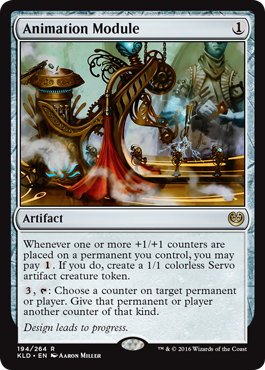
No, just use animation module.
I tested a thopter sword package and it was extremely underwhelming in this setting. I expected more that what it delivered.
I also have given consideration to both transmute and bridge, but elected to go other directions for assorted reasons. Good suggestions though. Bridge in particular is an area I'm attempting to address with Opposition. Primarily for the likes of sneak and reanimate targets and merit lage type stuff. So far it's given me what I wanted from that slot every time I've seen it in a game.
Make a dpot for animation module. That, plus ravager and hangarback is the stones. Much better than thopter sword.
You're gonna need an image or a link to convince me that's an actual card.
oh, Kaladesh, gotcha. I game almost exclusively on MTGO these days, so those cards aren't real to me until they are. ;)
Plus it's a one drop. Thanks for the pic in any case. Cool looking card.
One drop with chalice is unfortunate, but its really insane protection for ravager. Basically there is no way to plow it anymore, since you can just sack an artifact, add a plus one plus one, make a token, sack ravager and move the counters to the token. Ravager reads 1: +1//+1 counter, and with hangarback or steel overseer its also insane.
This looks like an odd mix between Tezzerator and Affinity; it's lacking a lot of the prison pieces that Vintage Ravager Shops will have (using this list for reference) but doesn't have much counter magic to save itself from, say, Blood Moon, which locks out a good chunk of the deck.
Does look kind of cool though. I'm interested to see where this development goes.
This deck already plays UB I would add R (with 6 Moxes you can already, just add a couple of Volcanic Islands) and go much deeper into the Planeswalker route.
Tezzeret Agent, ok
Jace, ok.
Daretti 2.0
Dak Fayden
new Saheeli (to fetch and win with her ultimate)
you can also stay back and rely on Daretti and Thopter tokens and Strix 90% of the match and then close with a Planeswalker ultimate.
This deck can
Chalice turn 1
Daretti/Dack/Saheeli turn 2
Jace/Tezzeret turn 3
control from there with card advantage (Jace, Tezzeret), help yourself with card quality (Dack Fayden) and grind him out of his misery (Daretti 2.0, Strix, Thopters).
Consider also how huge it is Dack Fayden looting ability with Daretti ultimate.
You discard a Wurmcoil Engine and you gain 3 on the field.
This deck screams for more and more Planeswalkers. You can always pitch the more you draw of to FoW and Misdirection (or just set them aside with Jace's Brainstorm)
playtested for fun: never without Daretti. you sac Mox Opal to get rid of his Emrakul or Jitte or really whatever.
3 or 4 of

This OP can't decide if he wants to play Tezzerator, Affinity or MUD. Makes no sense to discuss at all if the lacking synergy between Lodestone Golem and the rest of the deck (just to name one example) isn't obvious
www.theepicstorm.com - Your Source for The Epic Storm - Articles, Reports, Decktech and more!
Join us at Facebook!
THIS! Daretti is far too good not to run in this shell. Clear 3-of imo.
I think that Dack Fayden competes with Thoughtcast and I would like to hear why you prefer Thoughtcast, Snake Pliskan. I'm not sure either.
The lack of synergy between Golem and the rest of the deck has been mentioned, so I would cut it and would go up to 4 FoW to adress combo. FoW is online on turn 0, Golem on turn 2/3.
With all the artifacts in the deck, I would always run the 4th Tezzeret before Jace, because he wins you the game on the following turn most of the time.
Trinket Mage, EE and Sword also look weak.
I'm not sure about Ravager without creature support either. There aren't enough creatures to reliably counter removal like Swords to Plowshares by passing on the counters. The combo with Hangarback Walker looks nice on paper, but you won't draw both cards every game and Walker on its own seems rather underwelming.
Here's a rough sketch of what I would run:
4 Ancient Tomb
1 Glimmervoid
4 Darksteel Citadel
4 Vault of Whispers
4 Seat of the Synod
4 Great Furnace
4 Mox Opal
2 Mox Diamond
4 Thoughtcast
4 Force of Will
4 Chalice of the Void
4 Arcbound Ravager
4 Baleful Strix
2 Master of Etherium
2 Etched Champion
2 Phyrexian Revoker
4 Tezzeret, Agent of Bolas
3 Daretti, Ingenious Iconoclast
The list is untested, so the mana base as well as some choices like Revoker, Champion and Master are debatable.
I also think that another thread isn't required.
For me, these lists look like next level Affinity. The reason to play Affinity these days are its fast mana base centered around Mox Opal, Chalice of the Void, Daretti and Tezzeret.
EDIT: I have to say that Animation Module looks strong. With all the planeswalkers and Ravager, it seems to fit well into the deck.
Chalice on 1 hurts, but you can always sacrifice CHalice with Ravager or Daretti if needed. Hangarback Walker also makes more sense with Animation Module. So perhaps this is the ways to go:
4 Ancient Tomb
1 Glimmervoid
4 Darksteel Citadel
4 Vault of Whispers
4 Seat of the Synod
4 Great Furnace
4 Mox Opal
2 Mox Diamond
4 Force of Will
2 Thoughtcast
4 Chalice of the Void
3 Arcbound Ravager
4 Baleful Strix
2 Master of Etherium
3 Hangarback Walker
2 Animation Module
4 Tezzeret, Agent of Bolas
3 Daretti, Ingenious Iconoclast
2 Dack Fayden
Last edited by Smea.gol.lum; 09-10-2016 at 07:24 PM.
On the contrary, I know exactly what I want out of this build. It's none of the things you listed but shares overlapping components of all of them. Try to imagine the possibility you haven't seen everything there is to be seen in this world, and you'll begin to understand this deck is looking to find out if some of the cards have a wider range than the applications they've been used for up til now.
The lack of synergy you refer to between Lodestone Golem and the game plan the deck is seeking to execute is not at all obvious to me. Maybe you can clarify that in a way that isn't going to be just a rehash of the dialogue between ESG and myself on that subject. You're concerned about what exactly - finding a 5th mana source to play a 4 drop out of a deck just shy of 50% mana production with an 8 card cantrip suite that sidesteps all your lock pieces? If so, you're not focusing on the right kinds of details.
Interesting. I wouldn't have thought to compare the two directly. From the way I look at it, Thoughtcast is a one mana super cantrip. It fits perfect in this type of shell for a number of reasons. When you're constructing around a card like Mox Opal, you're given incentive to dump cards from your hand to turn on metalcraft immediately. Thoughtcast leverages the exact same conditions and absorbs the cost incurred in terms of cards in hand that was spent to jump your board ahead by a turn or two. It is also a natural complement to a disruption suite centered on chalice and lodestone. Lodestone tax is cancelled out due to counting itself for affinity discount. Alongside Chalice of the Void it offers a one mana cantrip that nets twice the raw card quantity relative to it's competition, which is also live when the others are off. Divination for U is not at all a fair or balanced card even in legacy, and that is essentially what Thoughtcast is the majority of the time, in most decks that are including it. You give up the option to play it turn one more than a small percentage of the time. That's a low cost in most decks that would want it, since they already by default have to be constructed to have a high density of immediate plays to the board. It is a very different deckbuilding constraint than something like Ponder, for example, that's routinely used to lead off and immediately manage card access before sequencing other plays.
In a lot of ways it is a mix between not only those decks, but a couple others as well. It takes multiple structural cues from a handful of proven outlines. It's not exactly looking to pattern it's play after any one of them however. You're correct that it contains only a sparse prison element. That form of disruption is one piece of the total package of tools at it's disposal. The lock pieces are efficient. If they're effectively deployed they represent a virtual exchange with multiple cards from the opponent's side while on the battlefield, so it's neither necessary or even attractive to add more while getting diminishing returns. They only need serve to delay opposing strategies rather than shut them down entirely when combined with the proper pressure along other axes.
Blood moon hasn't been a dealbreaker in the limited number of times I've faced it with this deck. A large percentage of the cards require no colored mana, moxen are still live, and there are also a few ways to access the basic island. Blood Moon doesn't stop artifact lands from continuing to be artifacts for the purposes of ravager or tezzeret. I'm not sure if I should be more concerned about it than I am but it doesn't sound too threatening. Thanks for giving your thoughts.
There are currently 1 users browsing this thread. (0 members and 1 guests)


 Reply With Quote